English
 Español
 عربى
عربى 中文简体
中文简体Upload your drawings, BOQ or specifications, and our team will review them for quotation and solution support.

Send inquiry

Upload your drawings, BOQ or specifications, and our team will review them for quotation and solution support.
Over the past decade, building facade design has been undergoing a profound "lightweight revolution." Through technical consulting for curtain walls on dozens of super-tall and large-scale projects, we have witnessed firsthand how aluminum panels evolved from an alternative solution to the preferred system for achieving complex geometries and withstanding harsh environments. While stone offers solidity and glass provides uniformity, the comprehensive performance of aluminum panels positions them closer to an "all-rounder." Yet, how are these advantages truly realized in practical engineering?
What does "lightweight" really signify? Its implications extend far beyond mere steel savings. In a practical case involving a large-scale building, replacing the originally designed dry-hung stone with 3mm aluminum honeycomb panels resulted in approximately 35% reduction of the total structural load. This decision directly optimized the thickness of the core wall, freeing up thousands of square meters of additional usable floor area. The design freedom afforded by lightness allows architects to more boldly employ formal languages such as cantilevers, voids, and steep angles, without structural engineers having to pay an excessive price. In contemporary architecture that pursues extremes, aluminum's density advantage has been transformed into tangible economic benefits and creative spatial potential.
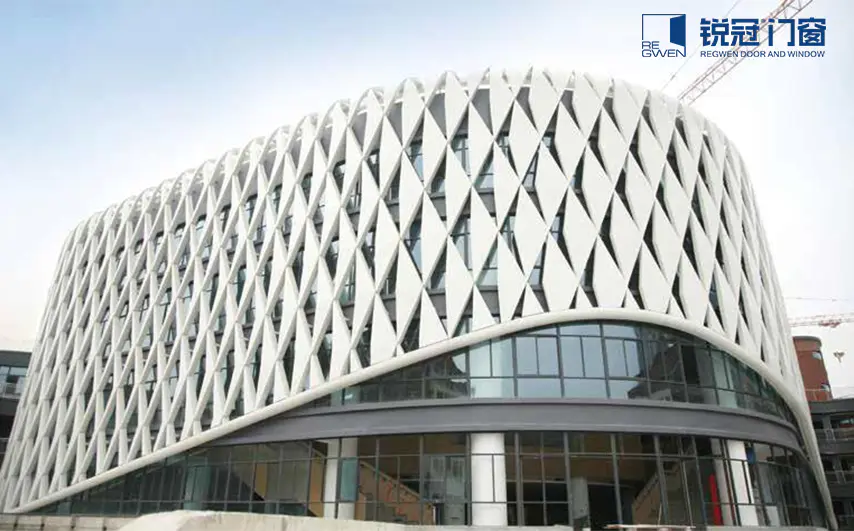
Nearly all suppliers emphasize the formability of aluminum panels, claiming they can achieve any curved surface. However, the real key lies in balancing cost and craftsmanship. Our practical experience indicates that single-curvature panels can be efficiently produced using roll-forming machines, representing the most cost-effective shaping method, while true double-curvature panels (with non-zero Gaussian curvature) rely on expensive molds or CNC forging and are suitable only for focal points. In a cultural center project, we used a small amount of double-curvature aluminum panels solely at the main visual focal point of the entrance, while employing single-curvature panels to approximate the form across large background areas. This achieved a fluid visual presentation at a controllable cost. Formability is not unconditional magic; its rational application is crucial.
The claimed 25-year weather resistance of aluminum panel curtain walls is by no means reliant on the base material alone. It represents a systemic commitment. First, coating quality is paramount. While fluorocarbon coating is mainstream, significant variations exist between brands and processes. A high-quality coating system should comprise a complete sequence of primer, topcoat, and clear coat, applied with strict curing procedures during manufacturing. Second, the reliability of connection details is vital. Leakage and corrosion in curtain walls often originate at fasteners and joints. We mandate that all exposed screws must be stainless steel, paired with EPDM gasket seals to eliminate the risk of electrochemical corrosion. Third, the often-overlooked "breathing system" – a rational cavity design and pressure-equalized rain-screen principle within the curtain wall assembly – is more critical than the panels themselves for long-term stability, ensuring proper drainage of condensate and preventing internal moisture accumulation.
Low maintenance is not synonymous with maintenance-free. Truly low-maintenance design begins at the drawing board. We prefer employing large-module, minimal-operable-window unit designs to reduce seams and moving parts, thereby lowering the probability of failure from the outset. For surface treatment, we prioritize medium-to-low brightness, matte-textured finishes, whose stain resistance and cleanability are far superior to high-gloss surfaces. Concurrently, it is essential to incorporate concealed, removable access panels to facilitate future inspection of the internal structure and anchorage points—a necessary safeguard for long-term safety.
Compared to the tendency of glass curtain walls to shatter upon fire exposure, the non-combustibility (Class A) of aluminum panels holds significant value for public buildings. In a high-traffic transportation hub project, fire authorities explicitly required that the cladding above main evacuation routes be constructed with Class A materials. In this context, the aluminum panel curtain wall was not merely a decorative layer but became an integral component of the passive fire protection system. Its metallic properties prevent the release of toxic fumes at high temperatures, buying crucial time for firefighting and rescue operations.
When engaging with decision-makers, we frequently conduct a comparative Life Cycle Cost analysis: While the initial material cost for high-quality aluminum panel curtain walls may be higher, their installation efficiency can improve by over 30% (benefiting from lightweight properties and dry construction methods), significantly reducing construction costs. Maintenance costs over a ten-year period are minimal (primarily cleaning), whereas stone facades may require periodic reinforcement. More importantly, after twenty years, the recyclable residual value of aluminum can reach 30-40% of the initial material cost, while the residual value of stone is nearly zero. Calculated over a fifty-year cycle, the total cost of ownership for an aluminum panel solution often demonstrates a clear advantage. Its value lies in distributing costs over a longer usage period and creating a closed-loop through end-of-life recycling value.
While the high recyclability of aluminum is a fact, genuine green practice should extend upstream. We now prioritize recommending panels containing a high proportion of recycled aluminum (some brands offer over 70% recycled content) and require suppliers to provide Environmental Product Declarations (EPDs). This approach holds more substantive meaning for current environmental practice than discussing recycling only decades later.
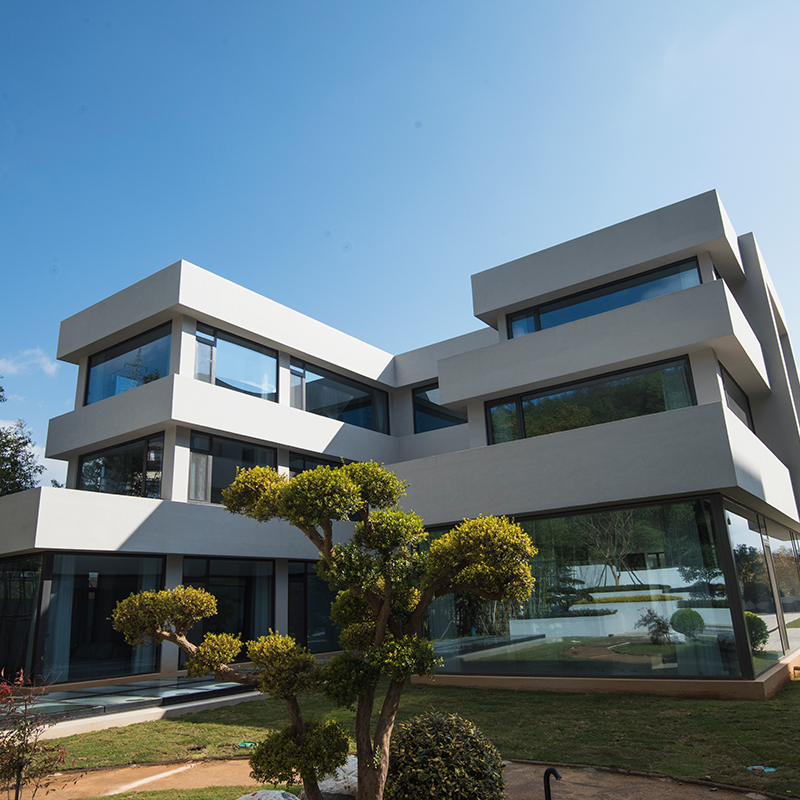
The widespread adoption of aluminum panel curtain walls is an inevitable outcome of the interplay between modern architectural technology, aesthetics, and economics. It is not without shortcomings—it is sensitive to initial cost and demands extremely high precision in fabrication and installation. However, when evaluated on the scales of environmental impact and economics, and considered as a tool for realizing specific architectural aspirations, its comprehensive value makes it the preferred choice. As producers of curtain wall systems, our mission is not merely to promote a specific material, but to substantiate its worth through multifaceted efforts in education, design, production, and service. Aluminum panels are undoubtedly the material of choice in contemporary exterior wall technology, worthy of the title.

Factory Address: No.21 Longfei Road, Qinghu Street, Jiangshan City, Zhejiang Province, ChinaHangzhou Office: Sanshen International Centre, Shuanglong Street, Jiangcun Street, Xihu District, Hangzhou, Zhejiang, China


whatsapp: +86-18072983795

+86-571-86632298
Copyright © Zhejiang Ruiguan Door and Window Co., Ltd. Rights Reserved.
 Wholesale Aluminum Alloy Windows Manufacturers